Saturday, 9 May 2015

Striking Gold!


Blog posts seem to be as rare as gold dust hereabouts at the moment, time to try and put that to rights a little I guess. Work, Spring and Life unfortunately all partially to blame - still coming to grips with all three. Oh, and Netflix too ...


The last post (which was itself a late post) started off with a nice list of birds which hadn't been seen recently at Stithians, and to be perfectly honest, probably wouldn't get seen. Of course this spring then saw an almost unprecedented influx of Hoopoes to south western Cornwall and Southern Ireland, along with a host of other southern goodies in ideal migrant influx conditions; none of which I saw (I probably should have made the effort to at least try and see the Woodchat Shrike over at Camborne, but I didn't).

Would Stithians be completely left out ... ?

 ... Keen followers of local bird news, or persons with excellent rep at guessing blog content from corny blog title headings may guess at what is coming. Local mining history aficionados will however probably remain a touch disappointed .... others will just have to keep reading (or just scrolling down and pretending to read.)

So, with further ado, to the important events of the date in question -

Sunday 26th April

Myself and Samuel Perfect had arranged to meet Daniel Eva to assist with the nestbox monitoring which he is carrying out this season around 11am on this fine sunday (it was meant to be a worse day, meteorologically speaking, than transpired).

Meeting Daniel by the southern hides there wasn't an awful lot of unusual activity to get excited about - there may have been a singing Garden Warbler in addition to the Blackcap which did show itself, yesterday's Sedge Warbler wasn't even heard, but some birds were definitely about ...

At the southern end -

2 Great Crested Grebe
2 Coot
5 Tufted Duck
Little Egret
4+ Cormorant
Sparrowhawk, male
Great Spotted Woodpecker over
3+ Buzzard etc

Around the feeders -

3 Greenfinch
Reed Bunting etc,

And on the southern cutoff -

2 Coot,
2 Little Grebe
Grey Heron, Canada Goose etc

Having checked the hides out properly, we then did some proper work, as it were, and surreptitiously and in an entirely and consummately professional manner monitored some nests and nestboxes, no little birdies were put out too much hopefully in our scientific quest for knowledge.

So to the real highlight of the day (aside Daniel Eva sinking nearly waist deep into a wet muddy hole whilst attempting to give Samuel (who didn't have wellies on) a helpful piggyback across a damp looking bit) was a rather nice and completely unexpected addition to the day - a cracking adult male GOLDEN ORIOLE which flew across the road ahead of us as we trudged along having finished the nestboxes in the southern area. A real bonus, it perched up briefly in the treetops before taking flight again northwards (despite some hopes we didn't encounter it again as we checked nestboxes at that end).

This was a lifer for Samuel, a Cornwall tick for me, and the first for Daniel for some years. And probably a Self-Found tick for all too, in accordance with the official Girls Aloud Self-Finding rules.

2 Stock Dove over at around this juncture probably would otherwise have been a major highlight (Stithians yeartick and all that).
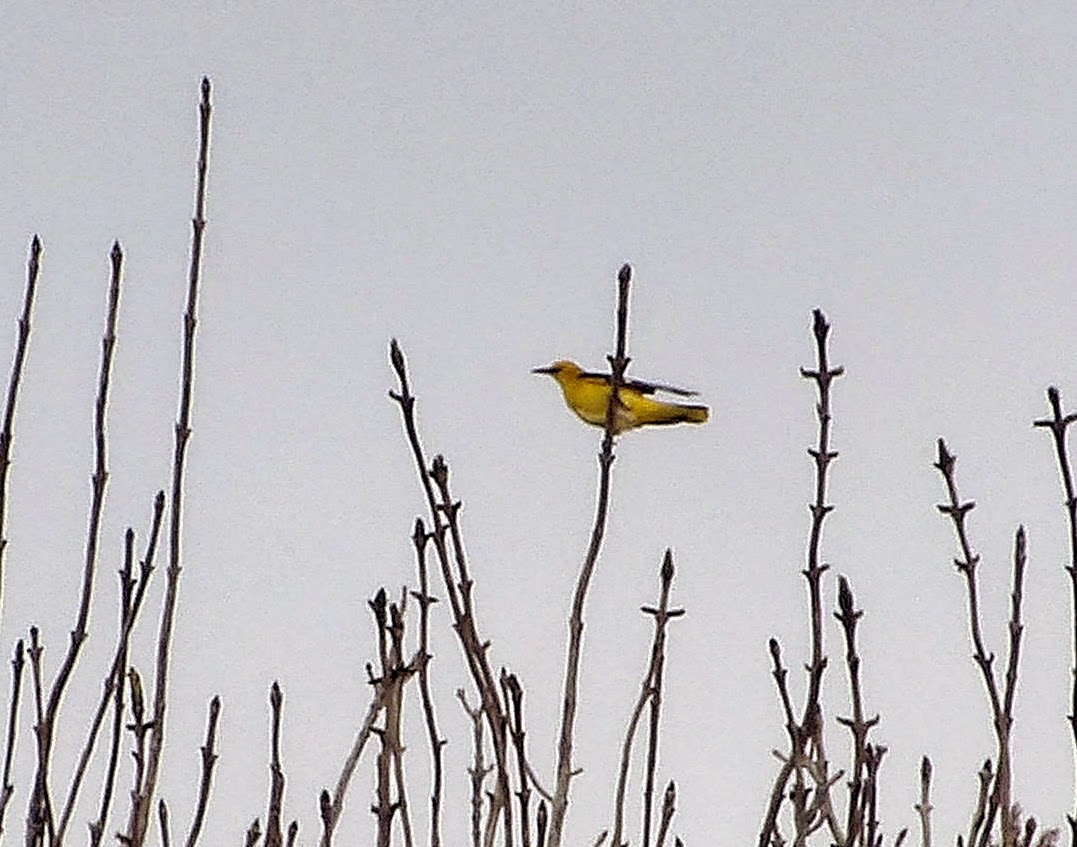

A cracking male Golden Oriole!


It perched briefly in full view, albeit a little distantly, before heading on north ...

Other birds encountered later included a calling Little Grebe and a third pair of Coot on the west side, with c.100 'large' gulls at the north end.

Butterflies included Speckled Wood, Small White and Peacock - more evidence of spring!


And the nest-monitoring itself?

Obviously some caution has to be exercised in this area, but currently (as of 26th April) -  7+ species proven nesting; Dunnock with 3 young, 3 Crow nests with eggs/young, Magpies, Buzzard, Long-tailed Tits, Song Thrush and the two common tit species all started or on eggs.

Stithians being inland, and rather exposed, the tits, especially, are not as advanced as other parts of the country (including various parks and gardens); all change soon presumably, as leaf unfold occurs and insect numbers take off (both the flightless and flighted ones).




Saturday, 18 April 2015

Spring is on the way ... late March update.


A couple of Hoopoe, Black Kites over, an Osprey tracking north, what's that buzzing cheery little song emanating from the conifers? Ah yes, a smart little Serin of course ...  if only these had been at Stithians. But nothing to get excited about as they weren't.

Just standard garden fare from my brief sojourn in France unfortunately. Not complaining, and possibly worth dragging myself, kicking and screaming away from the Falmouth area for ...

All good practise for when they do turn up ...

So to the (reasonably damp) reality that is Cornwall again - paid another flying visit en route from Falmouth to London and environs (for another family related visiting exercise) on the last Monday of the month. Getting up, packing, picking Samuel up (he'd somehow managed to cadge a lift back that way too), a touch of shopping and dropping some seed off and it was half one in the afternoon before we finally managed to arrive.

And unfortunately for the girlfriend waiting (im)patiently in the car, the visit wasn't actually that flying from then on in either - these things can't be rushed, and it was gone 3pm before we were to finally leave for our long drive east. In the meantime ...

... the feeders got filled, the waters were scrutinised and a nice bit of birding was enjoyed. Priorities! Sorry Suzi ... ;)

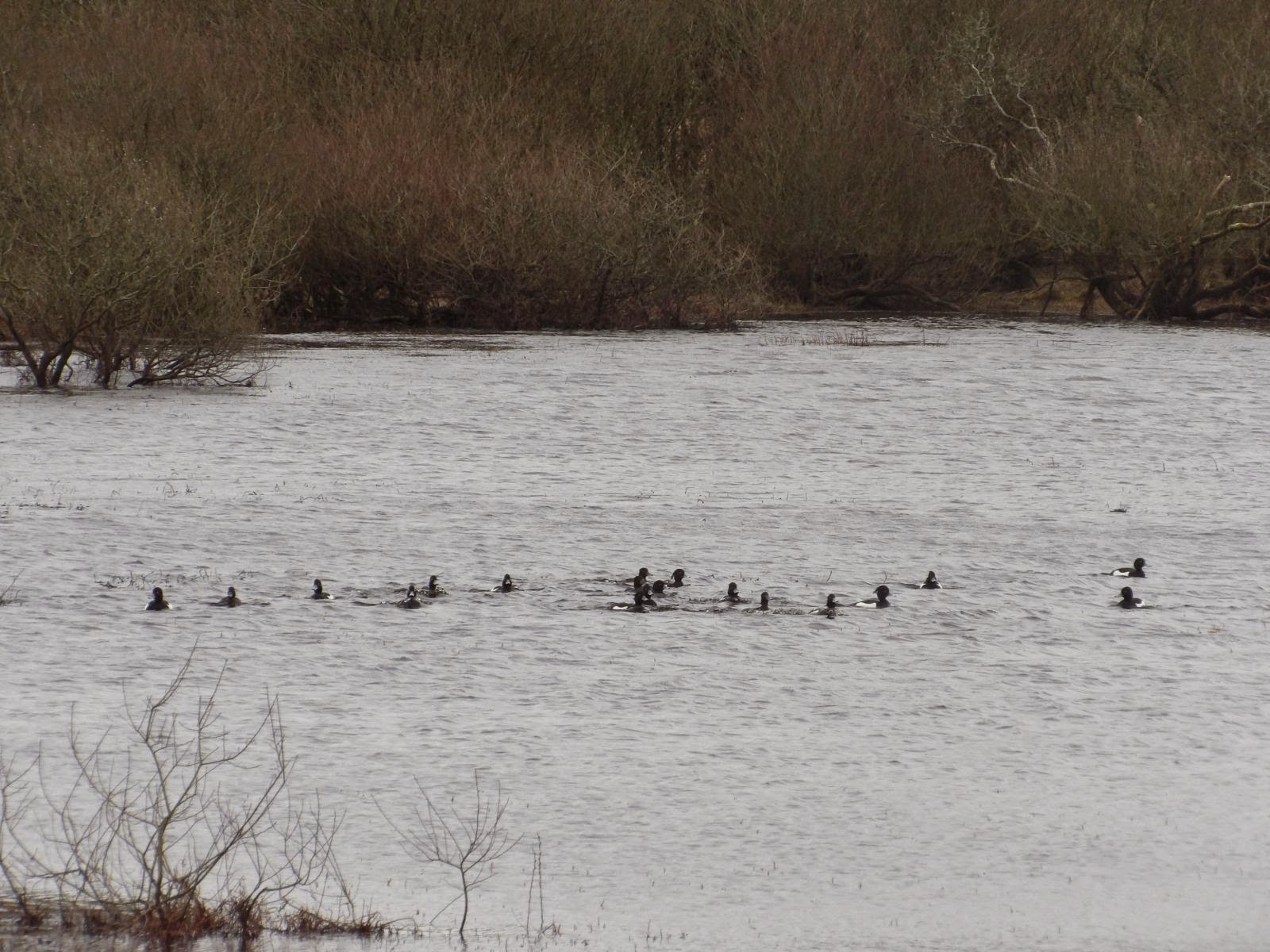
Apart from the feeders being practically empty (the usual state of affairs - think the birds, especially the Great Tits do it on purpose - throw all the seeds they don't like to the ground within the first half an hour of filling them up I reckon ... ), there was a noisy and excitable flock of 21 Tufted Ducks cruising around outside on the Southern Cutoff. Very nice, and perhaps the main flock from the Reservoir paying a visit, or numbers swelling from elsewhere. Nice.


Some of the excitable Tufted Ducks


A pair of Canada Geese also hove into view, and then proceeded to upend for our viewing pleasure.


The Canadas arriving. It would be rude to show them upending.

Other birds from the hide included 2 Mallard, 3 Teal and a Little Grebe on the water side, with reasonable numbers of passerines on/by the feeders as follows -

4 Reed Bunting (2 m 2f)
12+ Chaffinch
4 Dunnock
1 Blackbird
1 Robin
5 Blue Tit
2 Great Tit
2 Long-tailed Tit
2 Greenfinch
2 Goldfinch
6 House Sparrow

No Water Rail! This could well be because it has now moved on as the Zugunruhe* filling its little hollow air-filled bones led it inexorably up and away northwards ...

With six House Sparrow being a new record! Have only seen two at once prior to this, but have suspected more for weeks now, given the degree and volume of cheeky chirping coming from the bramble scrub further back beyond the feeders.


Male Chaffinch. Nice bird actually.


Male Reed Bunting. Full dress now.

Across to the other side and visibility was just about ok - birds were there and identifiable, but it was really quite closing on by the time we came to leave (and face the prospect of driving up to Kent in it, but that, as they say, is another story ... )

Didn't manage to see any Grey Herons on this visit, although the birder in the hide (from Porth way) did say he'd seen a Little Egret not long before we arrived.

What we did see were 2 Goldeneye (female type of course - and we'd actually seen them earlier as we drove across the causeway), a Great Crested Grebe (numbers seem sadly down on the high of 7 a few weeks back, although I'm sure it is about time a proper survey was carried out), the Slavonian Grebe still and 7 Little Grebes, many in dapper summer plumage now. Two Mallard, 3 Coot and a further 9 Tufted Ducks completing the line-up.

(* Zugunruhe - a German word describing the 'migratory urge' which takes over all migratory creatures when the time arrives.)

Selected March highlights -

Probably the major one would be the arrival of the first spring migrants proper with Wheatear (male) and Sand Martins (6) on the 19th (J St Ledger).

Bittern again - 22nd March showing opposite the Southern Hide, 4pm, R Menari
12 Magpies


Intermittent cloud closing in, southern arm.

Friday, 3 April 2015

Once Bittern ...

Wednesday 18th March -

Due to be away for the week to the parents in France, so my regular Friday visit swapped for the Wednesday, and a little later in the day ...

From the Stuart Hutchings hide -

11 Little Grebe
1 Slavonian Grebe (looking a little smarter perhaps)
2 female Goldeneye
2 Tufted Duck

From the Southern hide -

4 Wigeon
2 Moorhen
2 Little Grebe
3 Grey Heron
1 Canada Goose flew through

The seed feeders were already empty - but birds still kicking around, including a Reed Bunting and 3 Dunnock. One Blue Tit rather startled itself by flying towards the feeders whilst I was still filling them without seeing me until the last moment - if Blue Tits can look embarrassed this one would have looked very surprised and sheepish as it made a hasty mid-air about-turn when realising there was a big human only three feet away as it was about to land.

Hung around a little - checking out by the causeway in the hope of Woodcock starting to stir and checking the margins in the hope of the weekends Bittern, but no luck.


 The south west corner from the Southern Causeway


I couldn't be bothered to wait until actual dark (sundown was 18:25, and it was getting chilly), so at a quarter to seven called it a day. Turned the car around and was driving over the causeway to see a familiar shape flying over the road ahead - a real actual Bittern! Managed to track it's direction (whilst staying on the road myself), and pulled up half way across the causeway (in the pull in bit, but still left the lights and hazards on) - managed to pick it up stalking along the edge of the water. 

An unexpected car tick (don't actually recall whether I have previously picked one up whilst driving before), but very nice to see up at Stithians even if the views were not the best.


Managed to get some excruciatingly awful nice record shots of the Bittern - well worth sharing as ever. The bird may even be recognisable in some!


There's a Bittern on the other side somewhere!


And there it is ... zooming in with camera 


And after a bit of basic processing ...


 ... it really is one ... !

Would have been directly opposite the hide had I been there, but the light was continuously fading and I was hungry so left it at that ...

Brief update - disturbance to hides this Saturday morning.

Running behind again and better to post something up ... perhaps. Will update this post properly later on today.

Just to mention that there is a volunteer day organised for this Saturday and that there will be some disturbance around the hides - quite possibly to the extent that the hides will be unavailable to visitors at times in the morning.

Apologies for any inconvenience this may cause - hopefully the bright sparkly new nature of the hides in the ensuing weeks will be well worth the sacrifices made. I won't be present unfortunately - currently halfway across the country on familial duties but I'm sure The Team will cope well without me. Will be back soon ...


Tuesday, 17 March 2015

Friday 13th - lucky moving day. Again.

As luck/chance/fate, or none of the above would have it, it is exactly a month since the feeders were last moved - hence the title. It has a slight oriental ring to it, to my mind, and would have course been amply completed with a nice Chinese Pond Heron or something similar on site, but alas it was not to be. After a hard mornings graft (cleaning holiday lodges as the latest exciting task visited upon me by the agency), and it was over to Stithians with some more poles in order to refill the feeders and move to them a new spot within the area.


A couple of Blue Tits and some near empty feeders - if only they'd stop eating all the food!


As mentioned previously, the feeders need moving on a regular basis - this time it was back the way they came, but a little closer (hopefully to still give half-decent views for the pesky humans), hence the poles (ex-willow branches, not ex-agency staff from foreign lands of course). I didn't quite have enough, so a minor bit of cannibalism of the contraption t'other side was required, and the end result even more Heath Robinsy than before (or 'Rustic' to be more precise) but as long as the birds like it and it doesn't fall over too soon it's all ok as far as I'm concerned.


Mr Heath Robinson would've been proud ...


The Southern Hide and closest feeders


A nice red fungus (not it's real scientific name) from below the feeders


The feeders, despite being nigh-on emptied by the voracious hordes of winged guzzlers, were still as popular as ever.

Birds present -

1 Moorhen (showing well for once)
6+ Blue Tit
3 Great Tit
4 Dunnock
17+ Chaffinch
2 House Sparrow
6 Goldfinch (actually they were just flyovers - probably as a protest the nyger seed had all been consumed)
1 Magpie
1 Blackbird 
and 3+ Reed Bunting

Out on the water, 9 Wigeon still were nice, 2 Mallard proportionately less so, with 50+ Starling over being interesting, and one Muscovy Duck being of almost unmentionable and unparalleled beauty ... perhaps. 


A duck of superlative beauty? Hmmm ....


The waters on the main reservoir were pretty bleak and underwhelming, but there were still birds out there -

2 Great Crested Grebe
1 Grey Heron
1 Little Egret
1 Coot (it's crossed over!)
2 Cormorant
8 Little Grebe
4 Mallard
12 Canada Geese in the distant green field

with 1 Buzzard and 3 Carrion Crows over.

So no spring migrants yet ... and no sign of the Slavonian Grebe either. Perhaps it (and hopefully some more Great Cresteds were hiding in a sheltered bay, or perhaps my brief sweep of the waters failed to reveal them amongst all the wavelets.


Bit choppy and a nearly full reservoir

Other recent sightings -

Sometimes almost an afterthought, or tagged on the end but bird of the week at any rate in this portion (if you exclude the Muscovy Duck of course), and almost breaking news - a Bittern at Stithians for one lucky observer (Julie Martin) from the Southern Cutoff Hide on Sunday the 15th - only report this winter as far as I'm aware. Also -

Kingfisher, Water Rail and GSW on the 8th (J and F Rice)

Slavonian Grebe, 3 f type Goldeneye, 2 Snipe and 6 Reed Bunting on the 14th (J St Ledger)

Wednesday, 11 March 2015

Grebe City - 6th March 2015


Big news on the bird front from the weekend was the sudden arrival of a bunch of Great Crested Grebes - seven to be precise.


Myself and Samuel had turned up on the Friday 6th March on the way back from carrying out the WeBS count at a few sites on the Lizard to finally meet one of the regulars (Farleigh Rice - nice to meet you), and news that there were a pair showing outside the Stuart Hutchings hide. Being the non-twitcher that I am though, went to the Southern Hide first to check and fill the feeders, of course ...

The usual suspects were on show here of course, although a Raven in flight and the large white Muscovy Duck (readily confusable for a Mute Swan or even a Snow Gooses, with enough imagination?) were more unusual perhaps.


Raven in flight

Coot, Snipe, a bunch of Wigeon, and two Little Grebes - one of the latter appearing to be in full breeding dress were on show outside. I also managed to see my second newt of the year (presumably the commoner Palmate Newt) - as the one of the grebes swimming across the water was carrying one - a little sadly perhaps (for me; the grebe was quite a bit happier, and the newt probably really rather upset with the whole situation.)

Crossing over to the other side and it soon became apparent an influx of Great Crested Grebes had occurred - 3 pairs, two of which were showing varying degrees of amorous display and a further single. Along with at least another ten Little Grebes and the Slavonian also showing well at times it was a veritable grebe-fest! Interesting to wonder were they had all come from - the WeBS count on the Lizard had revealed there were still 11 on Loe Pool. Not checked Argal Reservoir yet where 7 or so have been hanging out all winter, but will get back on that one. Certainly they seem to be on the slight increase in the county of late.


Great Crested Grebes engaging in varying degrees of their iconic pair bonding ritual


 And a relatively dowdy Little Grebe 'scurrying' past


Ten distant Tufted Ducks, a quartet of closer Goldeneye (including the first smart male in quite a while), plus one other distant bird, and a handful of Wigeon, Mallard and Teal helped complete the lineup.


Goldeneye - smart birds those drakes

Enjoying the grebes and their displaying in the shifting waters we were also treated to a brief flight and sortie into the scrape (now wholly integrated into the waters of the reservoir, but you can still just about make out the outline of the bank from the ripples/wavelets/vegetation) from the long-staying Slavonian Grebe - nice. Still pretty much in winter plumage though, unfortunately.


Slavonian Grebe showing a nice bit of underwing

At least one Little Egret was still present (perhaps one day we'll suddenly notice they've gone for the season, and then be a little sad?), and our grebe-induced reverie was interrupted by a distant raptor over the far side - a Peregrine which landed on one of the distant fence posts bordering the lakeside footway. Excitingly, it then took off and headed our way, before repositioning into one of the scrubby windswept trees on our side.


Peregrine Falcon in flight. Rubbish shots of course, but just too exciting not to.
They always get the pulse racing a little ...
____

I returned the following day as a meeting had been arranged to discuss the proposed scrape from the Southern Hide. Tony B plus two offspring, and Greg were also present - it was good to get more of a handle on the score and meet on site. Unfortunately the morning's sun had disappeared long since.

The feeders were of course still dripping - 3 Blackbirds a new maximum, but 3 each of Long-tailed Tit, Reed Bunting, and wholesome numbers of the other regulars too of course. Three House Sparrow too! A Kingfisher on the far side was good (hadn't been reported for a while now). The Boring Old Water Rail present of course.


GSW - still playing hard to get


Checking out possible digger access, I inadvertently flushed two Woodcock from the woodland near the waters edge, exploding up from the ground near my feet, heavy chunky birds, rusty rump and tail and a side glimpse of the stout wooden bill ... they are always great birds to see. And if only I'd seen them before they'd seen me ...

As with any wooded site in Cornwall, it may be possible to catch up with these beasties around or after dusk as they move between daytime roosts in the more sheltered woods and feeding areas in damp fields for the night - a stakeout another time may well be in order.

Checking out the hide with Greg after, we picked up slightly lower numbers of  Great Cresteds and Goldeneye - down to 5 and 3 (no male) respectively. What we did spot distantly in the fields beyond, however, was a group of feeding Canada Geese (ultimately c.40) with what appeared to be 2 Greylag in amongst them. Hot-footing it over there before the light completely failed I was able to confirm they were indeed Greylag Geese and not obviously escaped farmyard geese - although one did have some odd paler feathers where it perhaps shouldn't have - bah! (Admittedly the whiteness of the feathers may be accentuated in post-processing, in the gloomy light this was not readily apparent at the time).


Greylags - the odd white feathers perhaps indicating some untoward influences at least ...

I also encountered my first Stithians Common Toad of the season along the way on the pathway itself ...


Bufo bufo, probably a male
___

Highlights from previous visits - still 7 Long-tailed Tits together back on the 27th Feb, 3 Fieldfare also over on the workparty monday (as I was carrying the tea tray back up t' track), and a few other bits and bobs.

No Weasels yet (see here if you have managed to as yet remain immune from this nationally breaking and very important story, are now a little intrigued and wish to be just a little amazed (with more on the internet at large of course, including various slightly funny/unfunny/hilarious memes (spoofs) on the subject)).

Looking forward to the first spring migrants of the year - the first Wheatears, Sand Martins and others have now been hitting the UK for a while now. Of course it will take a while before the main arrivals and the floodgates open, but eyes to the skies (and the bushes, waterways and other random scrubby habitats wherever a stray migrant may possibly be lurking ... )

Sunday, 8 March 2015

Changes ...

A million David Bowies can't be wrong ... or maybe they can?

Afraid that the past few weeks have been a bit busy for myself, apologies that the blog is only just now being updated ...

Change can only be a good thing, so they say. Not necessarily true ... but some is good. A few things have changed ...

Spring is moving onward apace ... buds swelling, bumblebees and butterflies emerging ... but not at Stithians yet much (to my knowledge), and a touch of wind and cloud cover and it would seem we are still in the icy grip of winter. But the first frogspawn can now be seen, and the sun does come out occasionally.


Frogspawn (the sun is yellower and a bit bigger, no photo, sorry).

___

So what else has been going on? - Well, firstly we didn't have a visit from the infamous BikingBirder (he did call by in 2010, before my time) - weather and running late in the Penzance area (boo hiss shame!) and the nearest he came to visiting the reserve was a brief sojourn in Falmouth (a bed for the night and the King Eider at Maenporth for second breakfast). Nice to meet, and good luck for the rest of the year.

(BikingBirder aka Gary Prescott, aiming to break the UK record which he jointly holds at 251 from his 2010 effort, and visit every single RSPB and WWT reserve in the UK in 2015 for charity. Both aims slightly, but not quite totally mutually exclusive.)

More here - https://www.facebook.com/bikingbirder2015

___

Possibly more relevant to most visitors (we also didn't have a visit from Elton John, JLS OR Chris Packham) was the first inaugural 2015 CBWPS volunteer work party on the Monday 2nd March. This was an official event featuring the hardcore team of myself, Dave Bray, John St Ledger and Greg Adams (the change gang?). Various tools, machines and misc. other items were wielded, a welcome flask of tea and biscuit selection was miraculously provided by some friendly neighbours (friends for life when cookies are the currency?!), weather was endured (I even experienced my first snow of the winter!) with several interesting wintry showers, and Fluorescent yellow jackets were even involved. (Most unfortunately, our official volunteer badges didn't make it in time).


Stuart Hutchings hide (with some evidence of Work Carried Out).


Overall it was a rather productive session (not sure if it was actually 'fun', admittedly) - more graffiti was wiped out (it would have been more if the battery had been more alive), the feeders were taken down and given a proper clean, a general tidy-up occurred, and work carried on in a rather serious fashion on the car parking front with involvement of multiple wheelbarrows and shovels - with the later addition of some surfacing there is now sufficient parking for a good quartet of visiting motor vehicles - indeed, a whole cavalcade, if one were to turn up.


One car - and room for more!!!

(I must be a rubbish Event Organiser - apart from failing to provide any Ginger Nuts or Chocolate Hobnobs for the Willing Participants I completely failed to get any axe-wielding volunteer shots or similar. Probably a good thing though in many respects ...)

___

There has been some discussion in the hide logbook concerning the position of the feeding station having been changed. The long and the short of it is that recommended advice from 'the authorities' (BTO/RSPB) is that feeders are moved on a regular basis (eg monthly) to minimise the buildup of infectious diseases on the ground and general area - some species (eg Chaffinch and Greenfinch) are particularly susceptible to some pretty nasty fungal and virus infections which can rapidly spread between birds in sites where birds congregate. More here -

http://www.birdforum.net/showthread.php?t=67323

(From the Hallowed pages of BF, sorry couldn't find the actual correct and original official links this time around)

At the end of the day the welfare of the birds comes first (and human visitors second, sorry!)


And just to confuse and possibly upset a different set of everyone (!), and taking on board the recommendations, the feeders will shortly be moving back in the direction they came from to give the ground below their current location a bit of respite ... however they should be able to be positioned a little closer and we'll see what we can do about a slight positional change ...

(In previous years I believe feeding has ceased as winter ends and the breeding season starts - I see no reason why we can't continue with the peanut feeders at least throughout the year (dependant on stock remaining) to maintain interest on site ... we'll see how it goes anyway.)

___

Not much on the birds this time I'm afraid - will hopefully remedy that soon (early this coming week) with exciting bird news and photos from the last week or two.

Some recent sightings from the logbook (Feb) -

27th Feb - Sparrowhawk from Southern Hide (Chris and Lindy)
28th Feb - Goldcrest, 6 Lapwing, 29 Wigeon, 4 Goldeneye (f) (D Eva)


These Wigeon wanted to be on the cover of Abbey Road, but their agent said No.